Uniquecoat® M5™ HVAF Gun
Redefining Efficiency & Coating Quality
The Uniquecoat M5 gun represents a major advancement in HVAF technology, achieving significantly higher deposition efficiency and coating quality when spraying HVOF-grade powders. This performance is made possible by its next-generation high-efficiency combustor and the implementation of independently controlled primary and secondary combustion zones, further refining the dual-stage combustion principle first introduced with the M3 and M4 guns.
Uniquecoat M5 HVAF Gun
M5 HVAF Spray Gun Overview
The Uniquecoat M5 is our most advanced HVAF spray gun, engineered to provide high process flexibility, outstanding deposition efficiency, and superior coating performance. It produces dense, high-quality coatings using standard HVOF-grade powders, significantly outperforming conventional M3 and M4 systems as well as conventional HVAF guns on the market.
● Enhanced Performance with Standard HVOF Powders – processes standard HVOF-grade WC- and CrC-based powders (15–45 µm), delivering coating properties exceeding typical HVOF deposits and up to 50% higher deposition efficiency than conventional single-stage combustion HVAF guns using the same powders.
● Flash Carbide Coatings Applied Without Hydrogen – applies dense, gas-impermeable carbide coatings with or without hydrogen. In both modes, coating quality is identical, so hydrogen becomes optional rather than necessary, simplifying the process and improving safety.
_edited.png)
Standard Industrial Grade M5 HVAF Gun
Standard M5 Configurations


What Sets the M5 Apart
1. High-Efficiency Combustor
● Advanced fuel/air mixture preparation ensures complete and stable combustion
● Reduces flame fluctuation and stabilizes the powder stream
● Improves powder heating, resulting in higher coating density and deposition efficiency
2. Independent Combustion Control (Dual-Stage Combustion Mode)
● Independently regulated primary and secondary combustion zones for precise process control
● Enables fine adjustment of particle temperature and velocity – the two key factors determining coating quality
● Expands coating capability – from fine HVAF powders to standard HVOF-grade powders
3. Flash Carbide Without Hydrogen (Single-Stage Combustion Mode)
● Deposits dense, impermeable Flash Carbide coatings without the use of hazardous gases
● Eliminates hydrogen entirely from the process, improving safety and environmental compliance
● Ideal for Near-Net-Shape (NNS) applications, producing smooth, dimensionally precise coatings
4. Lowest Air Consumption in Class
● Highly efficient thermal design maximizes energy utilization within the combustion process
● Reduces compressed-air demand and overall operating costs
● Minimizes compressor requirements, allowing use of smaller, more economical air systems
Dual Configuration Flexibility
The M5 is supplied with both single- and dual-stage combustion nozzle kits, providing maximum process adaptability. Operators can switch configurations in just 3–5 minutes, allowing the system to easily adjust to different powder types and coating objectives. This flexibility enhances overall operational versatility and efficiency.
Configuration Use Cases

1. Single-Stage Combustion Mode
Optimized for standard HVAF-grade WC-based powders for the application of Flash Carbide and Near-Net-Shape (NNS) coatings, where maximum coating density and fine surface finish are required.
● Handles ultra-fine powder fractions (e.g. 2–15 µm WC-10Co-4Cr) with excellent process stability
● Produces thin (15–30 µm), dense, gas-impermeable coatings with high thickness uniformity (Flash Carbides)
● Delivers as-sprayed surface roughness of Ra 1.1–1.3 µm, reducing post-processing requirements
● Supports all standard HVAF powders while maintaining high deposition efficiency

Designed for maximum heat transfer to spray particles when using standard HVOF-grade powders, significantly increasing coating hardness and deposition efficiency.
● Provides staged combustion via secondary fuel injection, enhancing particle heating
● Increases particle temperature without introducing oxygen, preserving carbide integrity
● Optimized for standard 15–45 µm HVOF powder grades and other coarse materials
● Produces dense coatings with superior hardness, adhesion, and durability
● Achieves up to 50% higher deposition efficiency than traditional single-stage combustion HVAF guns using the same powders
Combustor Options
The M5 gun supports two sizes of combustors, each optimized for specific material requirements:
● Short Combustor – delivers lower heat input; optimized for metals, metal alloys, and fine carbide powders that do not require prolonged heating

● Long Combustor – provides extended particle dwell time for improved heating; ideal for carbide powders requiring higher thermal input
All nozzles are standardized across the entire M-Series gun line and are fully compatible with either combustor. They can operate in both single- and dual-stage combustion modes, supported across both chamber lengths.
→ [Explore Conventional HVAF Guns]
Videos of M5 Applications
M5 Coating Application Examples
Surface Preparation — Hot Grit Blasting of Corrugated Roll
This video shows the hot grit blasting process used to prepare the surface of a corrugated roll prior to thermal spray coating. The method provides rapid cleaning of the complex corrugated geometry and ensures uniform surface activation across the entire profile. Hot grit blasting significantly reduces abrasive consumption and shortens preparation time compared with conventional cold blasting.
Hardware Configuration:
• Spray System: Uniquecoat M5 HVAF Gun (Long Combustor)
• Nozzle: Long, Dual-Stage Configuration
• Abrasive: 150-mesh alumina grit
Application Example — WC-Based Coating on Corrugated Roll
This video demonstrates the application of a tungsten carbide coating onto a corrugated roll.
The resulting coating exhibits low as-sprayed surface roughness and high hardness, providing excellent wear resistance and extended service life in demanding production environments.
Hardware Configuration:
-
Spray System: Uniquecoat M5 HVAF Gun (Long Combustor)
-
Nozzle: Long, Dual-Stage Configuration
-
Powder: WC-based, particle size +15 – 45 µm
Surface Preparation — Hot Grit Blasting of Turbine Disc
This video demonstrates the hot grit blasting of a turbine disc as a preparation step before thermal spray coating. The process rapidly generates a uniform, well-anchored roughness profile that promotes excellent metallurgical adhesion — critical for rotating components exposed to high mechanical loads. Hot grit blasting also minimizes grit usage and reduces overall preparation time.
Hardware Configuration:
• Spray System: Uniquecoat M5 HVAF Gun (Long Combustor)
• Nozzle: Long, Dual-Stage Configuration
• Abrasive: 150-mesh alumina grit
Application Example — Ni-Based Alloy Coating on Turbine Disc
This video demonstrates the application of a nickel-based alloy coating onto a turbine disc.
The high spray rate and excellent deposition efficiency of the M5 HVAF Gun equipped with the long dual-nozzle enable coating thicknesses of up to 300 µm to be achieved in just four passes.
The resulting coating exhibits near-zero porosity and is virtually free of oxides, providing durable protection against high-temperature oxidation and corrosion in turbine service environments.
Hardware Configuration:
-
Spray System: Uniquecoat M5 HVAF Gun (Long Combustor)
-
Nozzle: Long, Dual-Stage Configuration
-
Powder: Ni-based alloy, particle size +15 – 38 µm
Application Example — WC-Based Coating on Compacting Roll
This video demonstrates the application of a tungsten carbide coating onto a compacting roll.
The resulting coating exhibits low as-sprayed surface roughness and high hardness, enabling it to withstand high contact pressures typical of compacting operations.
Compared to HVOF coatings, the HVAF-applied layer offers significantly longer service life and superior resistance to wear and fatigue under heavy load conditions.
Hardware Configuration:
-
Spray System: Uniquecoat M5 HVAF Gun (Long Combustor)
-
Nozzle: Long, Dual-Stage Configuration
-
Powder: WC-based, particle size +5 – 30 µm
Demonstration — Spray Jet with Ultra-Fine Tungsten Carbide Powder
This video demonstrates the spray jet produced using an ultra-fine tungsten carbide (WC) powder with a particle size of +2–15 µm.
Note the jet’s remarkable stability and absence of pulsation — both critical factors for achieving high-quality Flash Carbide coatings.
Such consistency ensures a uniform coating thickness across the entire surface, which is essential for Near-Net-Shape (NNS) applications.
The demonstration was performed using the G4™ gravimetric powder feeder.
Dual-Nozzle Spray Jet with HVOF WC-based Powder (15–45 µm) — “Hot” Mode
This video illustrates the M5 operating in a high-energy hot-mode configuration to process a standard HVOF-grade WC-10Co-4Cr powder (15–45 µm). In this mode, the gun is equipped with the longest secondary nozzle and uses parameter settings optimized to deliver maximum thermal load to relatively large particles (compared to HVAF-grade powders).
Under these conditions, the system achieves particle temperatures sufficient for the effective application of standard HVOF powders, enabling deposition efficiencies up to 60% and coating hardness approaching 1,500 HV₃₀₀—performance unattainable with conventional single-stage combustion HVAF guns.
Dual-Nozzle Spray Jet with HVOF-Cut WC Powder (15–45 µm) — “Cold” Mode
This video shows the M5 spray jet produced using a standard HVOF-grade WC-10Co-4Cr powder (15–45 µm). The jet remains exceptionally stable and well-focused, with no detectable pulsation—an essential condition for achieving uniform, high-precision coatings.
In this demonstration, the M5 operates in a cold-mode configuration, using the longest secondary nozzle combined with reduced primary combustion and increased secondary fuel flow. This setup lowers particle temperature while providing strong oxidation protection within the jet core, making it particularly advantageous for spraying metals and metal-alloy powders.
Coating Microstructure
M5 Coating Cross-Section Micrographs

Hardness: 1200 HV300 Bond Strength: 8700-10200 PSI

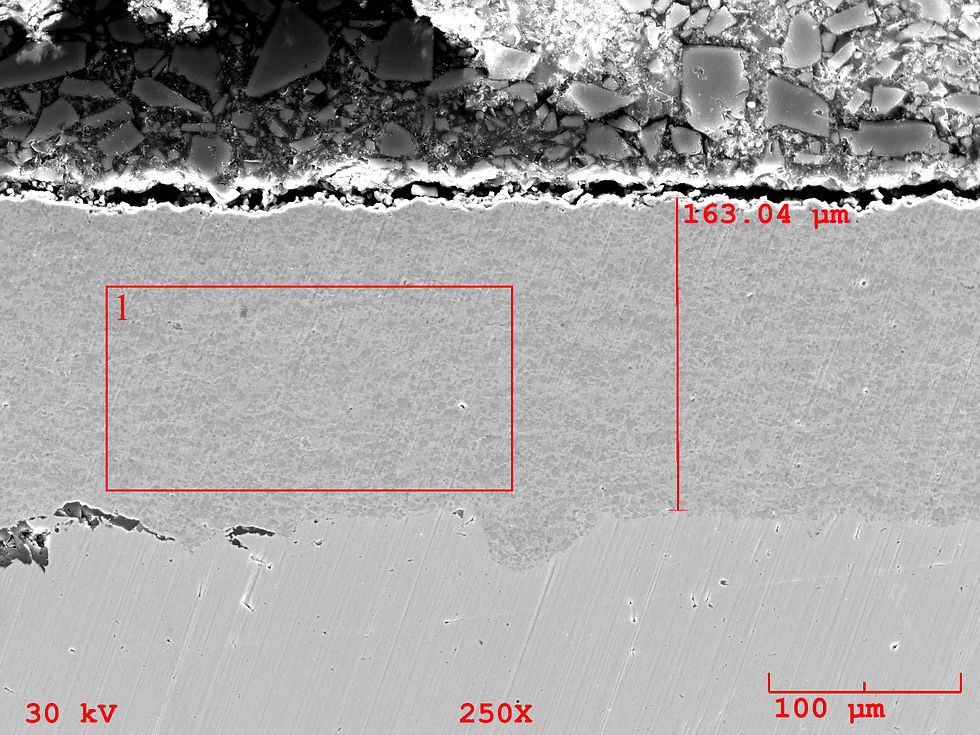
Hardness: 1200 HV300 Bond Strength: 8700-10200 PSI
